
Details
ISBN/EAN: 978-1-441-91559-7
Einband: gebundenes Buch
Weitere Details
Auflage:
1. Auflage 2010
1. Auflage 2010
Erschienen am:
19.02.2010
19.02.2010
Sprache:
English
English
Umfang:
xvi, 410 S., 60 s/w Illustr., 14 farbige Illustr.,
xvi, 410 S., 60 s/w Illustr., 14 farbige Illustr.,
Hersteller:
Springer Verlag GmbH
juergen.hartmann@springer.com
Tiergartenstr. 17
DE 69121 Heidelberg
Springer Verlag GmbH
juergen.hartmann@springer.com
Tiergartenstr. 17
DE 69121 Heidelberg
Weitere Details
arrow_forward_ios

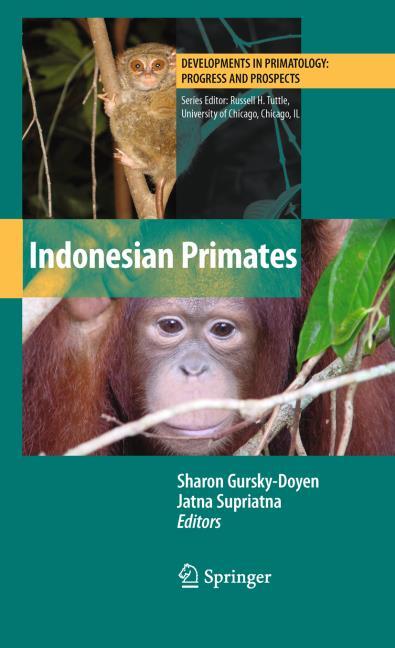
Indonesian Primates
Developments in Primatology: Progress and Prospects
267,49 €
inkl. MwSt.
Lieferbar innerhalb 1 - 2 Wochen
Beschreibung
Indonesia possesses the second largest primate population in the world, with over 33 different primate species. Although Brazil possesses more primate species, Indonesia outranks it in terms of its diversity of primates, ranging from prosimians (slow lorises and tarsiers), to a multitude of Old World Monkey species (macaques, langurs, proboscis moneys) to lesser apes (siamangs, gibbons) and great apes (orangutans). The primates of Indonesia are distributed throughout the archipelago. Partly in response to the number of primates distributed throughout the Indonesian archipelago, Indonesia is classified as the home of two biodiversity hotspots (Wallacea and Sundaland). In order to be classified as a hotspot, an area must have a large proportion of endemic species coupled with a high degree of threat including having lost more than 70% of its original habitat. Two areas within Indonesia meet these criteria. The tremendous diversity of primates in Indonesia, in conjunction with the conservation issues facing the primates of this region, created a need for this volume.


